

Manage maintenance mode
Open an App and select Maintenance. Where the maintenance page sits in the request path is explained in How domains, traffic controls, and the WAF fit together.
Team owners and admins can manage the page. Save changes doesn’t enable maintenance. The on/off toggle submits the full page currently shown in the editor, so confirming a toggle also saves any unsaved edits. Resolve editor validation errors before toggling.
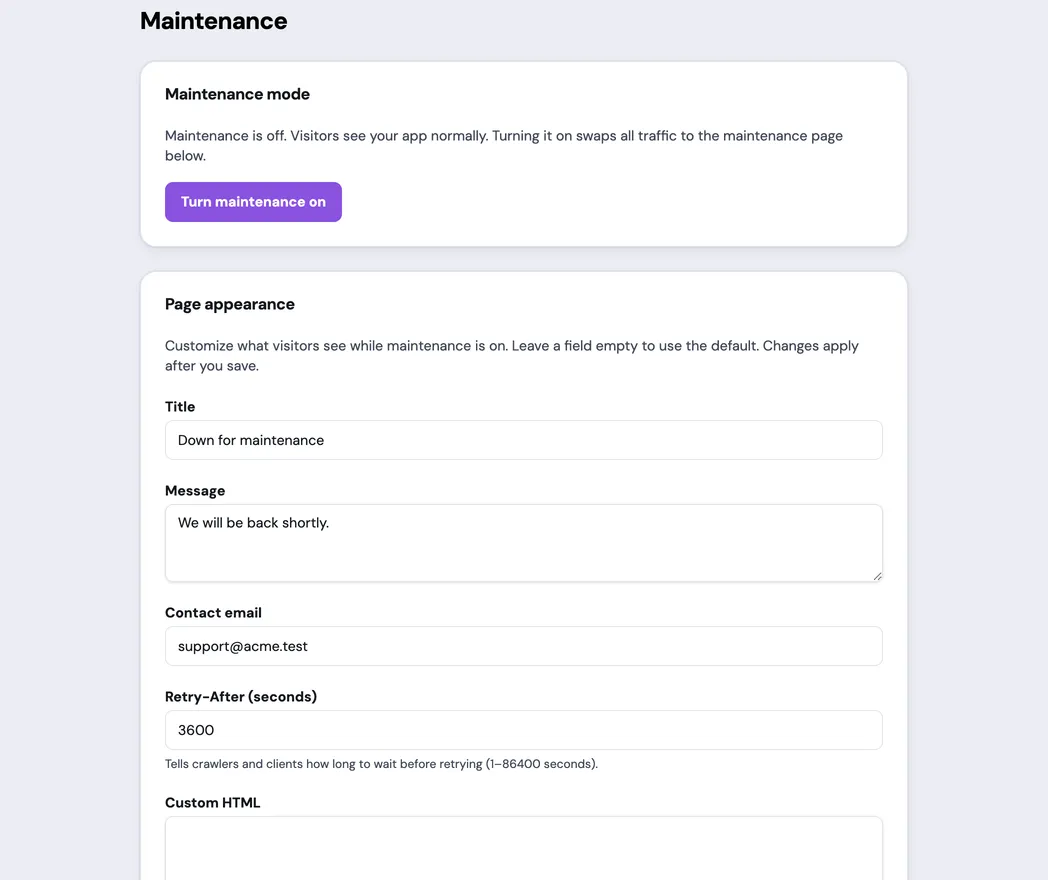
Configure the default page
Section titled “Configure the default page”Set the title, message, contact email, and Retry-After interval. Leave a field empty to use the platform default instead of pinning a custom value.
Retry-After tells crawlers and automated clients how long to wait before trying again. It must be a whole number from 1 through 86400 seconds.
Add custom HTML, CSS, and assets
Section titled “Add custom HTML, CSS, and assets”Use Custom HTML only when the standard title and message layout is insufficient. Custom HTML replaces the default page body. Scripts, event handlers, unsafe URLs, embedded forms, and similar active content are removed or rejected before publication.
Custom CSS styles the default page. If you replace the page with custom HTML, include the required styles in that HTML rather than expecting the Custom CSS field to apply.
Assets can be referenced from custom HTML with a root-relative path such as
/logo.png.
- Text assets support
.cssand.svgand are pasted into the editor. - Images support
.png,.jpg,.jpeg,.gif, and.webp. - Each image can be up to 5 MiB and 4096 by 4096 pixels.
- Referenced images can use up to 25 MiB in total for the App.
- Custom HTML can be up to 64 KiB.
- Custom CSS can use up to 32 KiB, and all text assets together can use up to 32 KiB, subject to the combined page-content limit shown by the portal.
- Asset names must be unique and use only letters, digits, dots, dashes, or underscores. Don’t include directories.
An image uploads when you choose the file, but it isn’t part of the published maintenance page until you select Save changes.
External CSS imports and external url() resources are rejected. Upload the
resource as an App asset and reference its filename instead.
Preview before publishing
Section titled “Preview before publishing”Select Preview to render the draft with the same validation used for a saved page. Review the content, contact details, spacing, and contrast before enabling maintenance.
The preview is intentionally isolated. Uploaded image assets referenced by their App asset filename are embedded in the preview. External network resources and separately linked stylesheets don’t load. A large or temporarily unavailable image can appear as a placeholder; confirm that the image row shows the filename, size, and dimensions.
Save and wait for the apply
Section titled “Save and wait for the apply”Select Save changes and wait for Saved - applying your changes to finish. The portal locks conflicting controls while the change is applying.
Saving an unchanged page can complete without a rollout. Don’t turn maintenance on until the saved page and its uploaded assets are ready.
Turn maintenance mode on
Section titled “Turn maintenance mode on”Select Turn maintenance on and confirm. All visitors see the maintenance page instead of the App until the change is turned off.
Wait for the apply status to complete before beginning work that assumes normal App traffic is no longer being served.
Turn maintenance mode off
Section titled “Turn maintenance mode off”Verify the App is ready, then select Turn maintenance off. Confirm that the apply status completes and the live URL serves the App again. Visitors who keep the maintenance page open are periodically refreshed so they can return to the App after maintenance ends.
Recover from conflicts or an uncertain apply
Section titled “Recover from conflicts or an uncertain apply”- A previous maintenance change is still being applied: wait for it to finish before editing or toggling again.
- Settings changed since you opened them or another change is in progress: select Load the latest, review the current state, and reapply only the changes that are still required.
- The change couldn’t be applied: adjust the page if the portal identifies a validation problem. Otherwise load the latest state before retrying.
- The maintenance service is temporarily unavailable: wait for the displayed retry interval, then submit the change again.
- The portal couldn’t confirm the change finished: select Load the latest. Don’t assume the previous click failed and submit a conflicting change.
- An image upload fails: confirm the format, file size, dimensions, and extension. Replacing an image with a different format also requires the matching filename extension.
After any recovery, verify both the portal state and the public App URL.